
A Blind Spot in Blue Finance

By Heading for Change and Sea Forward Ocean Health Fund
The ocean plays a central role in regulating our climate, and gets a sliver of the funding. Women do much of the work of fishing, farming and protecting it, but they get a sliver of that sliver. For investors who connect these threads, there’s a large financing gap and a solid return case and opportunity sitting in plain view.
The ocean covers more than 70% of the Earth’s surface. When its ecosystems are in healthy balance, it generates 50% of the oxygen we need, absorbs 30% of all CO2 emissions and captures 90% of the excess heat those emissions produce. It is, in effect, the climate system’s shock absorber.
Yet SDG 14 (Life Below Water) receives less than 1% of capital flows. That gap persists even though every $1 invested in ocean solutions is expected to yield $5 in global benefits by 2050. The return on investment is not in question, but the allocation is.
Like most development and impact finance, gender is largely missing from the conversation. Women play critical roles in fisheries, marine conservation, ocean research and coastal economies. But they are under-funded and often left out of decision-making and resource management. In Kenya, 74% of women who own micro-businesses in the blue economy lack access to capital. Globally, women-founded ventures continue to receive less than 2% of venture capital.
Women also carry a disproportionate share of climate risk. They are estimated to face greater economic vulnerability, health nutrition and other shocks. On the other hand, women are also acting as catalytic agents of change across the green and blue economies — as entrepreneurs, fund managers, investors and leaders of climate solutions.
Beyond the Blue: Looking at Ocean Investing Through a Gender Lens
A gender inclusion/diversity lens in climate investing isn’t about a new asset class or adding a pink label to an existing product. It starts from a simple gap: the women and communities closest to both the problems and solutions are often the most excluded in the capital, decisions and enterprises that shape the response. Closing that gap means understanding the barriers women face, the risks and opportunities they see and valuing the knowledge they bring. These insights, combined with financial and climate analysis, can help identify investment opportunities, better assess risk, and build more resilient solutions.
The same applies to ocean investing, where women’s ties to the ocean run through lived experience, culture, livelihood and stewardship. This is how a gender lens can apply across the entire value chain:
Women fund managers and asset allocators, who decide where ocean finance goes and who gets supported.
Women-led and women-owned businesses anywhere in the ocean economy, whether that’s seafood processing, aquaculture, marine tech or coastal tourism.
Quality blue jobs, training and leadership pathways for women within those businesses.
Products designed with women customers, built around the needs of the women who buy, use or sell them.
Climate-resilient livelihoods in sustainable aquaculture, coastal and mangrove restoration, and community-led conservation, where women’s work is often central but unpaid or informal.
Capacity building, from technical skills to access to networks and finance, so that women move from participants to decision-makers.
The goal is for capital, knowledge and opportunity to flow to women all along the ocean investing value chain.
The Tide is Turning for Ocean Impact Investing
In five years, the ocean has moved from a philanthropic niche to an investable theme with binding rules behind it. Two global treaties are now in force (the WTO Agreement on Fisheries Subsidies and the High Seas Treaty), and a 30x30 protection target is set. Investors at a recent convening noted that a large ocean fund would have been a non-starter four or five years ago.
The gap is still wide. A sustainable, inclusive maritime economy needs roughly USD 175 billion a year, and only about USD 30 billion has been disbursed in total since 2010. Blended finance, debt-for-nature swaps and blue bonds have all grown as ways to take some of the risk out.
For all that growth, women-led ocean businesses and women fund managers still make up a small share of deals, though more women fund managers are entering the space and training for women in the ocean economy is growing. There is more work to do in backing women-led ocean businesses and including women in the governance and design of solutions. Investors who get in now have a real chance to influence what the pipeline looks like as more capital arrives.
What Gender-Smart Ocean Investing Looks Like in Practice
More fund managers are building ocean and climate theses where gender influences who leads, who gets funded and who benefits. A few examples from the Sea Forward portfolio, across investments and grants:
AiiM Partners. AiiM Partners is a women-led growth investor in climate and biodiversity, founded by Shally Shanker, with more than half of its portfolio led by women or people of color. Its investment strategy also extends to ocean health, supporting technology-enabled solutions across areas such as sustainable seafood, plastic alternatives, ocean data and fisheries. AiiM applies an integrated gender and climate lens from opportunity mapping through to investment themes, assessing both the risks to women and the opportunities for their economic empowerment and leadership. This is a fund both SeaForward and HfC have invested in
Circulate Capital. Circulate Capital invests to stop plastic waste from reaching the ocean, and its first Ocean Fund was the first plastic circular economy fund to qualify as a 2X investment. In 2025, Sea Forward invested $150,000 in its Ocean Fund for Latin America and the Caribbean, including $100,000 contributed by Heading for Change. The fund finances recycling infrastructure in a sector where the informal workforce is overwhelmingly female, and its Gender Smart Investment Strategy requires portfolio companies to adopt unbiased hiring and safeguarding policies and supports training, pay equity and workplace safety for women across supply chains.
Mana Blue Planet. Mana Blue Planet is a women-led fund at Mana Impact, headed by Patti Chu, financing early-stage blue economy companies across Asia. One of them, Ikanesia in Indonesia, turns local fish waste, agricultural by-products and algae into aquaculture feed priced more than 25% below imported fishmeal, and works with more than 25 women-led processing groups.
Women in Ocean Food Innovation Studio (Hatch Blue). The Women in Ocean Food Innovation Studio is run by Hatch Blue with Conservation International Ventures, this equity-free program supports women founders building ocean food businesses across Latin America and the Caribbean, tackling their unequal access to capital and networks with a 9-day in-person studio, mentorship, 12 months of follow-on support and introductions to impact investors. Sea Forward supports it with a grant, alongside its investment in Hatch Blue’s Blue Revolution Fund.
Rhun Island women’s group (Coral Triangle Center). Through the Coral Triangle Center, a small Sea Forward grant supported a women-led group on Rhun Island, Indonesia, to build a community-based waste management system, bringing in school children, the village government and the wider community.

How Sea Forward Fund Builds Gender into the Investment Process
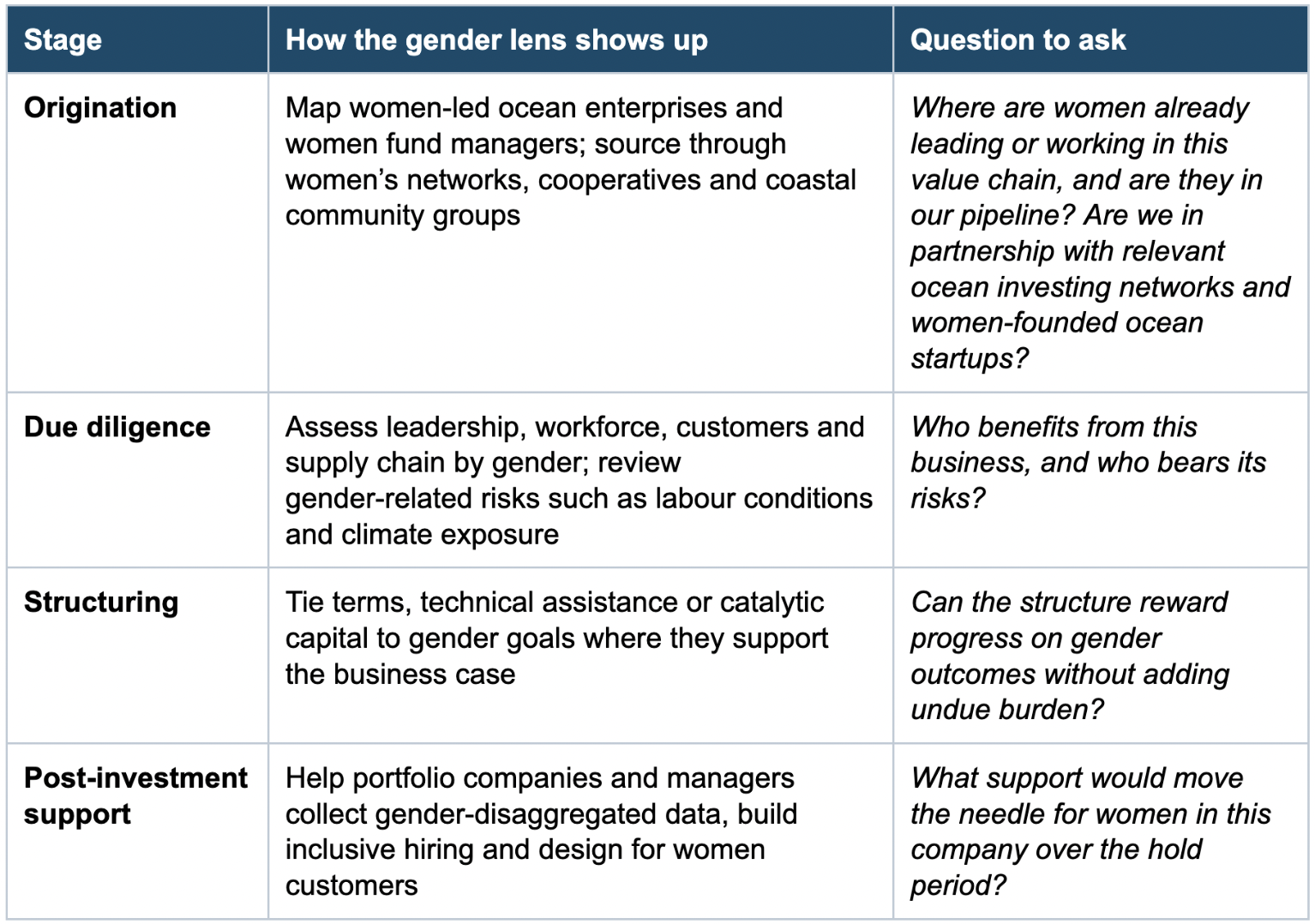
A gender lens works best as an intentional practice built into every stage of the investment process, not a screen applied at the end. The approaches below show how that can look for an ocean strategy.
The Sea Forward Ocean Health Fund is a women-led, multi-donor donor-advised fund at ImpactAssets, founded by marine biologist Laura Francis. It combines grants and impact investments across a global portfolio of ocean funds. Gender awareness and equity are built into how it invests. Team diversity and women in leadership is a weighted criterion in its scoring matrix, alongside strategic fit, ocean impact and risk and return, and the team looks closely at who is managing the capital and who is shaping the strategy.
Tools and Questions to Sharpen the Investment Thesis
Existing climate and gender tools can be extended to cover the ocean rather than rebuilt. For example, oceans can be integrated into the HfC Scorecard and due diligence questionnaire (DDQ) by adding a small set of targeted questions:
Thesis
1. Does the fund’s ocean thesis include an explicit investment focus on women and diverse ocean entrepreneurs?
2. Do you consider the role and impact of women as part of your investment thesis? What roles do women play in your target sectors, and how is this reflected in your oceans strategy?
Product and value chain
1. Are you investing in ocean and blue economy businesses that make or offer climate-smart products or services that are better for women?
2. Does your thesis actively address the specific risks facing women in your focus sectors, and the vulnerability of women and girls to those risks?
Process
1. How gender-aware is your investment process, for example in sourcing and market mapping? Do you collect gender-disaggregated data?
2. How does the fund help its ocean portfolio create quality blue jobs and opportunities for women, in the workforce and across the supply chain?
Put Your Capital to Work
The ocean finance gap won’t close on its own, and a gender lens won’t appear by default. Investors and philanthropists can act on both today, at whatever scale fits.
Move philanthropic capital into an oceans donor-advised fund (DAF). Pooled vehicles that blend grants and investments, such as the Sea Forward Ocean Health Fund, let donors back early-stage ocean solutions and the women leading them. Anyone can join Sea Forward on CataCap from $200.
Co-invest. Join ocean and gender-smart managers on specific deals to build conviction, learn the sector and add capital where it is most catalytic.
Build a dedicated oceans strategy, with gender embedded from the start. Use the diligence questions above to shape the thesis, the pipeline and the metrics, rather than retrofitting gender later.
Leverage climate and gender tools such as the HfC Investment Toolkit, starting with the step by step guide to get you started on your inquiry of how climate, oceans and gender can intersect in principle and in practice.
The ocean absorbs much of the climate crisis. The women who depend on it, work in it and innovate for it are ready to do more with the right capital. The opportunity is to fund both at once.